.
RATING: 73%
The first time I watched Following, my dad tapped me on the shoulder as the credits were rolling to ask what “art house flick” I’d just seen.
You can imagine his surprise when I told him it was Christopher Nolan.
For those unaware, Christopher Nolan may just be the biggest director currently in the industry, renowned for his consistently monumental projects with big budgets that deserve to be seen on the largest screen possible.
Aka, the opposite of art house.
Art house is a film genre that targets more niche markets (away from the masses) and is often accompanied by minimalist production through a project’s filmmaking and casting.
Aka, the opposite of Nolan.
Or so we think.
Interestingly, many who have worked with Nolan over the years have said his projects have an “art house” feel; actors often say that his sets feel intimate enough to work with a sincere balance of creative freedom and intentionality, regardless of the film’s budget or scale.
And as an actor, that’s the dream.
One of Nolan’s greatest strengths as a director comes through his ability to stay true to the integrity of a story and not “sell out” any aspect of the creative process for the sake of audience appeal.
*cough cough* Marvel
…
But has this always been the case for Nolan?
(Yes)
Who knows.
(I said yes)
Regardless, it all started with Following.
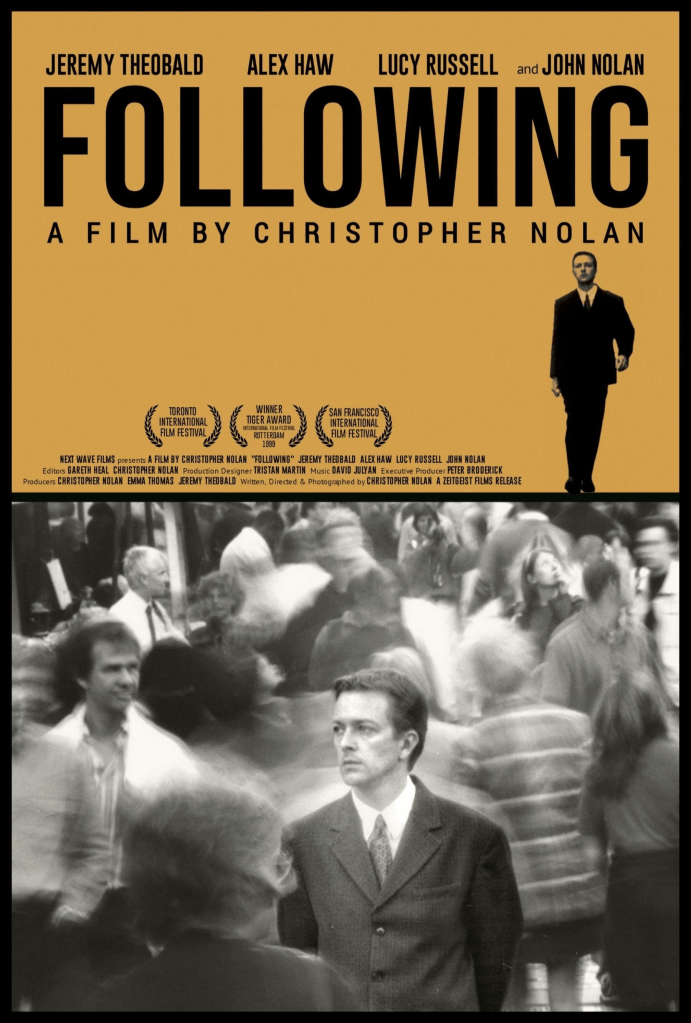
Nolan’s first feature film is a 1998 “art house flick” (according to my father) that gives us a glimpse into his storytelling genius without going much further in terms of its execution.
When I was 16, I wrote that it was some of his best writing accompanied by some of his worst directing (as I sat on my couch).
While I didn’t have a clue what I was talking about, this may be the only thing 16-year-old me said that I actually agree with.
I’ll explain.
Nowadays, when you go see a Nolan movie, you know it’s going to be an experience. He has free reign and full creative control over his films, which is evident in the way he continues to push the boundaries of what it takes to make a good one.
(Like crashing a f***ing plane)
That said, it hasn’t always been so obvious.
In Following, it almost feels like Nolan’s holding back. Don’t get me wrong: the dialogue is compelling, the story is clever and the characters are (fairly) well fleshed out, but there’s a lack of intensity that likely stems from Nolan not yet realizing what he’s capable of.
(And fair enough; he was 28)
But I think it worked out perfectly; Following is the precursor to the rest of his filmography…just with a little less money (yet the same number of developed female characters).
Jokes aside (I’m not joking), to get anywhere substantial in life, you have to make mistakes and struggle at certain points; thus, Following is simply a growing pain that doesn’t actually hurt.
At all.
Rather, it represents a necessary stepping stone on Nolan’s path to directorial dominance; not only does it foreshadow Nolan’s obsession with nonlinear storytelling, it also grants us the opportunity to notice more of the unnoticeable.
For instance: people.
Everyone knows Nolan for his mind-bending antics, but there’s an element of exploring human behaviour that plays an integral – yet subtle – role in many of his films.
And Following is a prime example.
Where he “holds back” in production, he makes up for with a calculated (and somewhat risky) script. The premise of the story involves stalking and varying levels of creepiness among characters who don’t seem to be overtly evil but also struggle to reckon with their actions and – in some cases – their pasts.
So it’s weird, but you’re interested.
(At least I was)
Anywho.
Few young directors can turn an “art house flick” into a provocative psychological commentary, Nolan’s take on the neo-noir genre has us questioning the morality of every single character, which is impressive for someone whose legend status has been cemented despite his films’ (supposedly) hollow understanding of interpersonal dynamics.
*exhales*
In any case, there’s something about the intimacy of Nolan’s Following that has become a phenomenon in its own right after seeing his career progress.
Through the years, Nolan has often looked to blend intimacy with existentially large-scale stories, and, in a way, one might argue that every film he makes could be a love letter to the one that started it all.
But you’d have to ask him.
.
Favourite Character: Cobb (Alex Hew)
Best Performance: Jeremy Theobald
 Blogs and Other Things
Leave a comment