Having trouble understanding the beautiful game on ice?
Fair enough; it’s fast.
Here’s a guide to help you understand how it’s set up, played, and formatted, which should clarify any confusion if you’re new to the sport.
.
Preface: this is more of a logistical guide into understanding the mechanics of the sport, so if you’re more interested in following the NHL itself (which is probably more fun), click here.
.
Setup
In short, hockey is played on a 200-foot long ice surface with a puck that weighs 6 ounces. Players wear skates and equipment while using curved sticks to handle the puck.
Like a number of sports, the goal of hockey is simple: to win, score more goals than the other team.
A game of hockey entails three 20 minute stop-time periods (60 minutes in total), where stop-time implies that the clock stops at every whistle.
Teams switch sides every period, but they do not switch benches, which makes the second period particularly tough for rotating players on and off the ice.
There can only be 5 players from each team on the ice at all times, excluding goalies. However, a team can take their goalie off the ice and replace them with a sixth skater, which teams often do to push for a goal when trailing late in a game.
There are 2 linesmen and 2 referees in a hockey game: linesmen call icings and offsides (which we’ll get to), while referees call penalties, signal goals, and blow the whistle whenever else it’s required.
.
Ice Layout
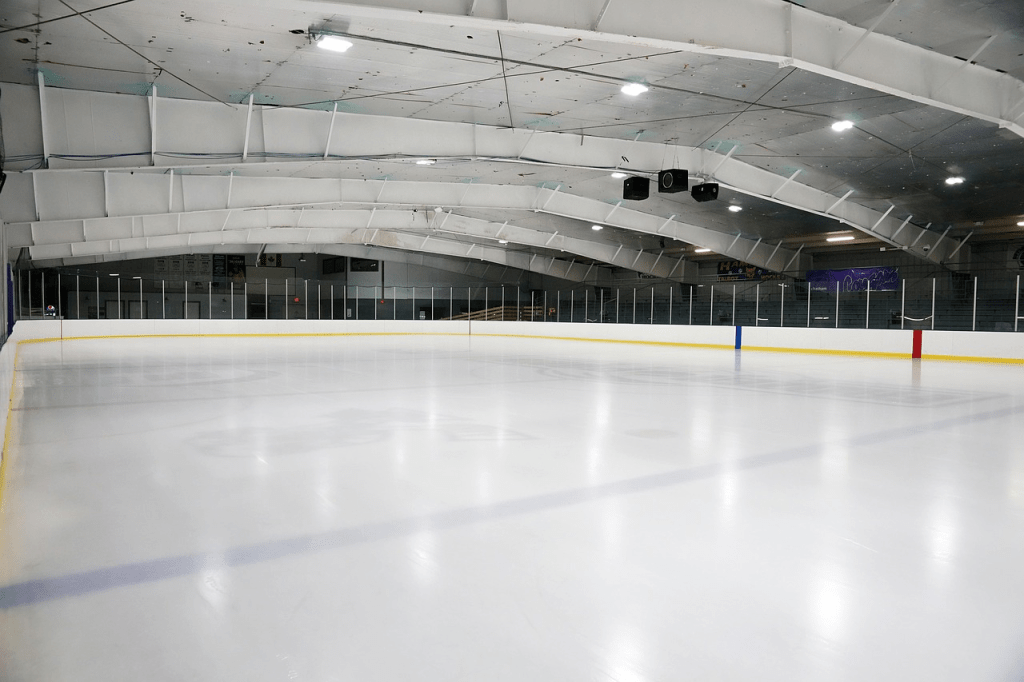
There’s a red line at centre ice stretching the width of the ice, with two blue lines symmetrically spaced on either side of the red line (which also both stretch the width of the ice); these lines embody the entrances into either team’s “zone.”
There are also two thinner red lines on either end of the rink (also stretching the width of the ice), which are used to signify “icing” and the “goal line” in the net.
There are five painted circles on the ice: two in each team’s zone to the right and left of the net, and the fifth one at centre ice.
Face-offs after whistles/goals or at the start of a period/game usually take place at the dots in these circles, unless the whistle is for offside or the puck goes out of play in the neutral zone (the central space between the two blue lines). In this case, the face-off takes place at one of the four dots located just outside of each team’s blue line.
While the ice is too long to see it all in this photo, the lines along the boards should make it clear.
.
How To Play
A goal is scored when a player shoots the puck into the net; the goal does not count unless the puck completely crosses the goal line (the thin red line we just talked about).
In the regular season, if teams are tied after 3 periods, there is a 5-minute 3-on-3 overtime, and if they are still tied after that, there is a shootout.
In a shootout, each team chooses 3 shooters to attempt to score on a breakaway, which is what it’s called when a player has a clear path to the net with no defender in their way.
If the teams are still tied after the first 3 rounds, it is sudden death, which means that as soon as one team scores and the other misses, the scoring team wins the game.
If no one has won after every player on the team has shot (excluding goalies), only then can a player shoot a second time. This is incredibly rare, but it has happened (and it often makes for a spectacle).
.
Some Basic Rules
- Offside: If a player crosses the opposing team’s blue line before the puck does, offside is called, unless the opposing team has brought the puck into their zone themselves. The resulting face-off is taken just outside the blue line where the offside occurred, unless the linesmen deem the offside “intentional,” in which case the face-off may be moved further up the ice.
- Icing: If a team shoots the puck past the opposing team’s goal line from their own side of centre ice, icing is called. The resulting face-off is taken at one of the circles to either the right or left of the net in the zone of the team who iced it.
- Body contact (often called bodychecking) is allowed in professional men’s hockey; while the rules are slightly different for women, contact is still allowed.
.
Penalties
Here’s a brief overview of hockey penalties.
Minor penalties (2 minutes):
- Tripping: Tripping another player with a stick or body part.
- Hooking: Hooking one’s stick into another player’s hands or body.
- Slashing: Swinging one’s stick at another player, often hitting them or their stick.
- Interference: Impeding another player who doesn’t have the puck.
- Goaltender Interference: Impeding or checking the goaltender.
- High-Sticking: Touching another player with the stick above shoulder level. If blood is drawn, the penalty is 4 minutes.
- Cross-Checking: Hitting another player with one’s stick while holding it with two hands above the ice.
- Charging: Taking more than three strides or jumping before hitting another player.
- Diving (Embellishment): Exaggerating the effect of a hit in an attempt to draw a penalty against the other team.
- Delay Of Game: Usually called when a player shoots the puck directly over the glass in their defensive zone.
- Holding: Grabbing another player with one’s hands or stick.
- Roughing: Pushing or shoving after the whistle is blown or when it takes place away from the play.
- Boarding: Pushing, tripping or checking another player violently into the boards.
- Kneeing: Hitting another player with one’s knee.
- Holding The Stick: Holding another player’s stick with one’s hand.
- Too Many Men On The Ice: When a team has more than 5 players on the ice (excluding goalies).
Major penalties (5 minutes or more):
- Fighting: Generally involves dropping the gloves and fistfighting another player.
- Illegal Check To The Head: Hitting another player where the player’s head is targeted and/or the principal point of contact.
- Unsportsmanlike Conduct: You can figure this one out yourself.
While there are many more, I attempted to keep it short; these are what you’re most likely to see in an average game.
.
NHL League Format
The NHL is hockey’s most competitive professional league.
The 32-team league is split into two conferences: East and West, and within those conferences, there are two divisions each (four total).
In the East, we have the Atlantic Division and the Metropolitan Division. In the West, we have the Central Division and the Pacific Division. Currently, each division has eight teams, though this may change as the NHL looks to expand in the future.
.
NHL Points System
The regular season is 82 games, and the top 3 teams from each division plus the 2 next best teams (called wild cards) from each conference make the playoffs.
Standings are based on points; during the regular season, a win is worth 2 points, a loss in overtime/shootout is worth one point, and a loss in regulation is worth no points.
If two teams are tied in points at the end of the regular season, the team with more regulation wins (RW) will finish higher in the standings. If they are still tied in regulation wins, the team with more regulation and overtime wins (ROW) will finish higher.
.
NHL Playoff Format
The NHL playoffs consists of 4 rounds, each being a best-of-7 series; thus, a team must win 16 games in order to win the Stanley Cup (though they will all but surely play more).
Round 1: In the first round, division winners play the wild card teams while the 2nd and 3rd place teams within each division face off. The division winner with the most points faces the lower-ranked wild card team (we’ll call this series A), while the other division winner plays the higher-ranked wild card team (we’ll call this series B).
Round 2: From there, the winner of series A plays the winner of 2/3 within that same division; likewise, the winner of series B plays the winner of 2/3 within theirs.
Round 3: From there, the winners of those series (and the last two teams standing in their respective conferences) face off.
Round 4: And from there, the winners of the East and the winners of the West battle for the Stanley Cup.
.
There are plenty more intricacies to the game of hockey, but this should be a good starting point if you’re looking to get into the sport!
If there’s any questions you have, or anything you think I should add, leave a comment down below or email me at ericfrazer@pursuing.ca!
Now sit back and enjoy the miracle on ice.
 Blogs and Other Things
Leave a comment